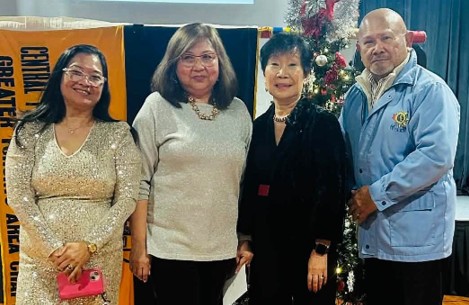
Message by Margaret Rose Dominado, International Liaison Officer of the Central Philippine University, Capiz Emmanuel Hospital, Iloilo Mission Hospital Nurses Alumni Association (CCINAA), during the Central Philippine University Alumni Association of Greater Toronto Area (CPUAAGTA) Thanksgiving and Christmas Party, held on November 7, 2026, at the Kalayaan Community Center, Mississauga, Ontario, Canada.

We are gathered here to reconnect and celebrate with our fellow Centralians. Let me invite you to reflect on this: Why do we join an alumni organization? Is it just for fun? To fill empty moments? Or did we do so to uphold the heritage of faithfulness, and to remain linked to the Centralian community built mutually on sacred trust so that our Central Spirit will continue to live on and on in the hearts and minds of those who will come after us? Central Spirit is the bond forged by a shared history of missions, ministries, fraternities, and sacred trust.
CPU alumni associations are nurtured in that sacred trust of their graduates, the donors, and the Centralian community they serve. And for that trust to remain sacred, it must be guarded with absolute integrity and experienced by the community.
This is the “spirit” behind the call of Positively Centralians fifteen years ago: “No transparency, no donations.” I was misunderstood back then as a troublemaker and as anti-CPU.
It was during the board chairmanship of Atty. Peter Corvera that the Positively Centralians group was recognized as a valuable participant in the Centralian community. We coordinated the livestreaming of the selection of our CPU president, Dr. Ernest Dagohoy. Today, ten thousand Positively Centralians continue to uphold their original commitment to transparency and accountability, honoring that sacred trust just as they have from the very beginning.
Our university was established with a sense of mission and a ministry founded in the Baptist tradition, which enables us to lead with character.
CPU did not only grant us degrees and a diploma; it instilled in us a set of core values anchored in its vision that is committed to Exemplary Christian Education for Life (EXCEL) and responsive to the needs of the total person and the world.
CPU’s core values of Faith, Character, Justice, Stewardship, and Excellence equipped us to live with a purpose and to lead with character.
Here’s another moment of reflection: As Christians and Centralians, how do we lead? When we reflect on the life of Jesus Christ and how He led His disciples, what do we see? Did Jesus measure leadership by how many people served Him under His power, or was His focus on how He could serve many people?
Leadership is usually associated with power. And so, when you hear the word “power,” what do you imagine it to be? The common idea of “success” includes possessing a specific brand of power—the ability to dominate a narrative, dictate terms and conditions, and bend outcomes to your own benefit. Right?
The sociocultural norms out there portray the leader as the one who sits at the top of the pyramid, the loudest voice in the room, the person with the highest status and the most authority. So, when you think of a “powerful” person, what image comes to mind? Think about this: Jesus Christ flipped the pyramid upside down and founded a counterculture of servant leadership. It is all about service to the least of our brethren, the marginalized.
Christ-centered leadership is challenging us to rethink what it means to be powerful and assess our capacity to act effectively with others in a globally connected world of the internet, Wi-Fi, and intersectionality. The global world is operating in a rapidly evolving network with unprecedented connectivity. Given this new reality, new models of power are emerging.
Power and influence in a connected world are relational. Power can belong to those who can build bridges and manage shared dependencies. There is power for those who know when to step forward, and when to pause, listen, and allow others to lead. The most influential person will not be the one who shouts the loudest. Influence belongs to the one who understands that true strength lies in empathy, collaboration, and collective resilience. Leadership is relationship, not control.
It is not unusual for persons in leadership to have this default tendency to accumulate influence and power by keeping it all to themselves—whether it is expertise, information, or networks (like alumni chapters). On the contrary, I have seen and experienced power-sharing that creates value for others, and in return, makes you invaluable to them. Power-sharing is about listening and giving voice to the unheard, facilitating spaces for the growth of others, and generously sharing opportunities and moments of greatness. To be powerful is to empower.
One of my favorite authors, Walter Wink, an American Biblical scholar, theologian, and activist, wrote in his book Naming the Powers that “we will search in vain for a definition of power because it is a word everyone understands until they are asked to define it.” Wink defined “the Powers” uniquely, expressed in a formula:
P = O + I
O is Outer Manifestation, which represents the material, structural, and political elements of power such as political and economic systems, laws, corporations, institutions, appointed and elected officials, and other physical leadership roles (like the “chair” of a committee or board).
The letter “I” represents Inner Spirituality. It is the invisible corporate spirit, ethos, or collective consciousness that gives energy to an institution or system (the “spirit” of the system), such as corporate culture, organizational culture, the morale of the team, or the nationalism of a country. For our university and its alumni, it is the Central Spirit.
At Kaiser Permanente, where I work, our HR conducts a series of workshops and training sessions to imbibe the culture of Trust, Safety, and Gratitude, requiring managers to always say thank you to the rank and file for the work that they do and to ensure they trust the leadership and feel safe enough to speak up.
For us Centralians, what kind of Central Spirit do we hope shall prevail? True power is the interweaving between inner spirituality and outer manifestations. In other words, genuine power is the inner soul that has achieved clarity and becomes a purposeful, dynamic force with a deep, constructive capacity to create and manifest lasting, fundamental change.
Transformative power—whether spiritual, relational, or personal—shifts perspectives and structures from domination (“power over”) into a shared “metamorphosis” that manifests across human experience, faith, and leadership.
Christ-centered leadership is transformative. Please take note that transformational leadership significantly differs from traditional transactional leadership, which focuses on rewards, performance, and control. Transformational leadership does not seek to build its own kingdom, but rather to create conditions that facilitate transformation that is fundamentally better for the group, organization, or community. I can see that manifested by your alumni chapter through your outreach programs.
The true authority of Christ-centered leadership is not a privilege based on title and position. It is earned through character. A leader who genuinely cares for her constituents speaks truthfully; the ego takes an exit to allow truth to be at center stage of the drama while she still holds herself accountable. This calls for character and courage, not perfection. A Christ-centered organization thrives in an environment where doubts are replaced by faith and self-interest is replaced by shared purpose. Sacred trust is sustained.
A Christ-centered leader is not someone who asks her chapter to make her look good and successful. Instead, she asks, “What can I do for you so you can optimize your God-given talents?” This kind of leader is willing to come down from her ivory tower, roll up her sleeves in the trenches, and remain unseen because this is not about her. Her focus is on how her efforts can impact the organization and its members rather than public recognition. She is the quiet cornerstone of the organization.
Christ-centered leadership features a leader with transformative power who is people-focused. She inspires, motivates, and encourages her constituents to exceed expectations and ensures the alignment of their personal values with a shared vision and mission to serve others. She communicates clearly and honestly and provides meaning and purpose to the endeavors of her organization. She is not afraid of challenging the status quo with, of course, calculated risks. She is a strong role model of integrity with high ethical standards—dedicated, respected, and trusted by her members.
Christ-centered leadership requires unquestionable integrity and authentic humility. This is a challenge for leaders to be courageous enough to do what is right, particularly when no one is watching, in a society where cutting corners is often rewarded. Leaders must manage resources with transparency and accountability. In a status-conscious culture such as ours, pursuing personal prestige is normalized. In contrast, the Christ-centered leader’s identity is anchored in Christ, and thus, she does not need to steal credit or exploit others as steppingstones. She is not afraid of truth. She is secure in her own identity.
Authentic humility is the quiet acceptance of who we really are—not perfect, only human enough to strip away the masks we wear to appease the crowd—and the refusal to become a mere image of what others prescribe for us.
Please indulge me as I share a story about my son, Chad Martin, a lawyer in Manila. I was never prouder of him as a mother than the day he told me the reason why he quit his high-level role in government. This happened a few years ago. He said that he would never bend to anyone’s pressure that contradicts the rule of law and his own personal principles. He refused to affix his signature to transactions that were questionable. Well, of course, that’s understandable, as I am his mother. He is like me in so many ways.
What gave me pride and joy, however, was when he added that he was beginning to get used to privilege, influence, and power, and he was afraid it would eventually corrupt him. He acknowledged his humanity and was aware that the seduction of power can be difficult to resist. He told me that what I said to him on the day of his appointment stuck with him. I simply said that what would make me proud and happy was not success, power, or wealth. All I asked of him was to maintain his integrity inside the lion’s den: For what profits a man if he gains the entire world, yet loses his soul?
As the mother of this young man, it requires me to check myself every now and then on whether I adhere to my mantra, which is also my favorite hymn:
“I would be true, for there are those who trust me;
I would be pure, for there are those who care;
I would be strong, for there is much to suffer;
I would be brave, for there is much to dare.”
In an era of social media and manipulated narratives, a Christ-centered leader speaks clearly and truthfully, exposing lies and deceit, and calls out those who bear false witness against their neighbors. She does not silence critics through intimidation. In her heart and soul, she embraces authority simply as a sacred trust given by God, thus requiring her to lead with humility.
I am aware that most of you care deeply about our institution’s legacy and its credibility as much as I do. Having said that, what I value the most is our kindred spirit: the Central Spirit in us and with us.
Our alumni organization is only as strong as its foundation. There are times when our organization stands at a crossroads where trust has been shaken, transparency compromised, and misinformation blurs our shared vision and mission.
I believe that our alumni organizations should have a Christ-centered framework to be true to their historical heritage of faithfulness. We must address issues within this framework. We should pursue justice, truth, and accountability while guarding our own spirit against self-serving motives and bitterness. We should always remind ourselves that the goal here is protecting sacred trust and restoring the credibility of our organization, rather than pursuing a personal vendetta or securing power for ourselves.
In moments like these, we must look beyond secular remedies to find our way back to a Christ-centered organizational culture. In this context, the framework of power is transformative. Transformative power inspires and encourages us to create trustworthy conditions that enable meaningful and productive change to happen.
How we respond as an alumni body will define who we are as Centralians. It reflects our Christian witness and our responsiveness to the world and to others. To stay silent in the face of corruption is to devalue the legacy of our Alma Mater.
Remember the lyrics of the Central Spirit song?
Hope of coming generations,
Gleaming dawn of day!
Filled with lofty veneration,
All we think and say,
Central Spirit leads us onward.
Loyal make each son and daughter
Till we find our efforts honored
With the Master’s words, “Well done!”
Let us stand together, worthy of the name Christians and Centralians, and embark on a Christ-centered journey that challenges us to rethink power as character, integrity, and courage, and redefines leadership as transformative—focusing on others rather than ourselves.
Thank you for making me a part of your fellowship and holiday celebration. It is such a pleasure, even for just a moment, to enjoy your company and friendship.
May God bless us all!